
OVERVIEWTank, tankless and Rinnai — diagnosed on-site, priced in writing
Sherwood Plumbing repairs and replaces tank, tankless, and heat-pump water heaters across Sherwood, Tualatin, Tigard, and Washington County — with on-site diagnosis by appointment and a written quote before any work begins. Cold showers are how most people find us: the tank’s been sitting in a closet or a garage for 8 to 12 years, running quietly, until the morning it doesn’t. By the time you’ve checked the breaker, looked at the pilot, and flipped the reset button, you’re calling a plumber.
Water heater repair is the most common call we take across Sherwood, Tualatin, Tigard, and the rest of Washington County. Most of the time the question isn’t “can this be repaired.” It’s “should it be.” A 10-year-old tank with a stuck gas valve or a bad element is usually worth replacing, not repairing, because the rest of the tank is about to fail anyway. A 3-year-old tank with the same symptoms is almost always worth the repair. Our job on the diagnostic visit is to give you a straight answer, including what we’d do if it were our own house.
NEED A PLUMBER NOW?Call or text (503) 822-5070
WHAT YOU NEED TO KNOWWhat types of water heaters does Sherwood Plumbing service?
We repair, install, and replace tank-style gas and electric water heaters, tankless units (Rinnai, Navien, Rheem), and heat-pump hybrids — for homes across Sherwood, Tualatin, and Tigard.
- Tank-style gas water heaters. Most homes in our service area. The big three: Rheem, Bradford White, A.O. Smith. Common issues we repair: pilot assembly, thermocouple, gas valve, dip tube, sacrificial anode, T&P valve, plus heating element replacement on electric models.
- Tank-style electric water heaters. Common in older Sherwood, Tigard, and Wilsonville homes without gas service. Element and thermostat replacement is usually the fix.
- Tankless water heaters. Rinnai, Navien, Rheem. We install, service, and replace. Tankless issues are usually scale from hard water, the flow sensor, or the igniter. Annual flushing is a service we offer and recommend.
- Heat pump water heaters (hybrid). Newer technology, showing up in Villebois and Charbonneau new-builds. We service these and install them for customers who want better efficiency than standard electric.
OUR APPROACHShould you repair or replace your water heater?
Age is the deciding factor: a storage tank past 10 years old is usually worth replacing, while a tank under 5 years with an isolated failure is almost always worth repairing. A few rules of thumb we use when we diagnose:
Age matters more than the symptom. Storage tanks have a real-world lifespan of 8 to 12 years. Past 10 years, we lean toward replacement because the tank’s internals are near end-of-life even if the failed part looks isolated. Tankless units run 15 to 20 years.
Corrosion on the tank is a one-way decision. If we see rust on the tank itself (not the fittings, the tank), the tank is failing. No repair fixes that.
Burnt odor, soot, or a yellow pilot flame means combustion is wrong. Sometimes a cleaning fixes it, sometimes the burner assembly needs replacement, sometimes the venting is compromised. We figure out which before we quote anything.
Repeated element or thermocouple failure on an electric or gas tank points to water quality issues upstream. Replacing the part without addressing the cause means the same failure in 18 months.
If you’re weighing the spend, we broke the numbers down in detail: what a water heater replacement actually costs in Sherwood.
THE DETAILSWhy convert from a tank to a tankless (Rinnai) water heater?
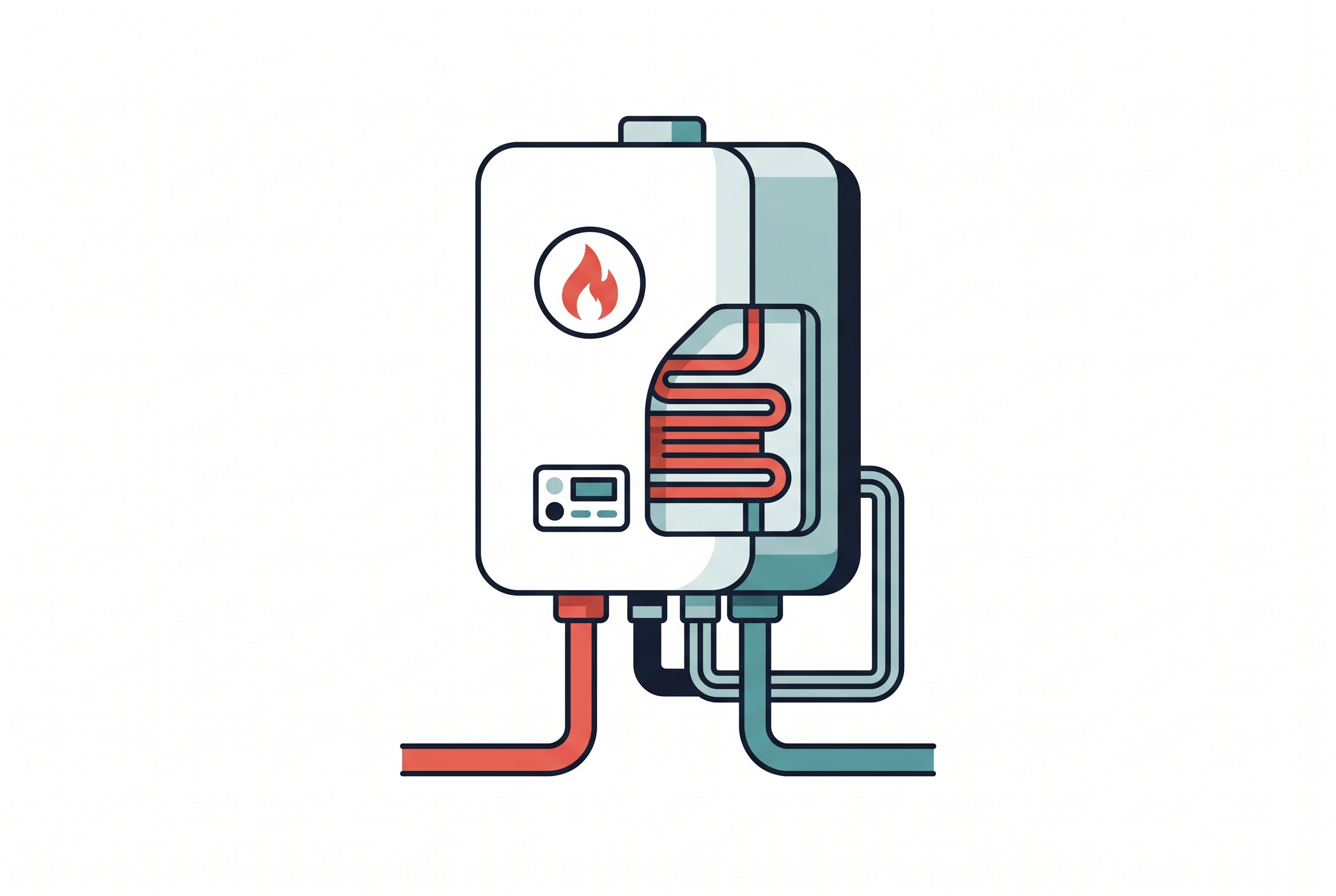
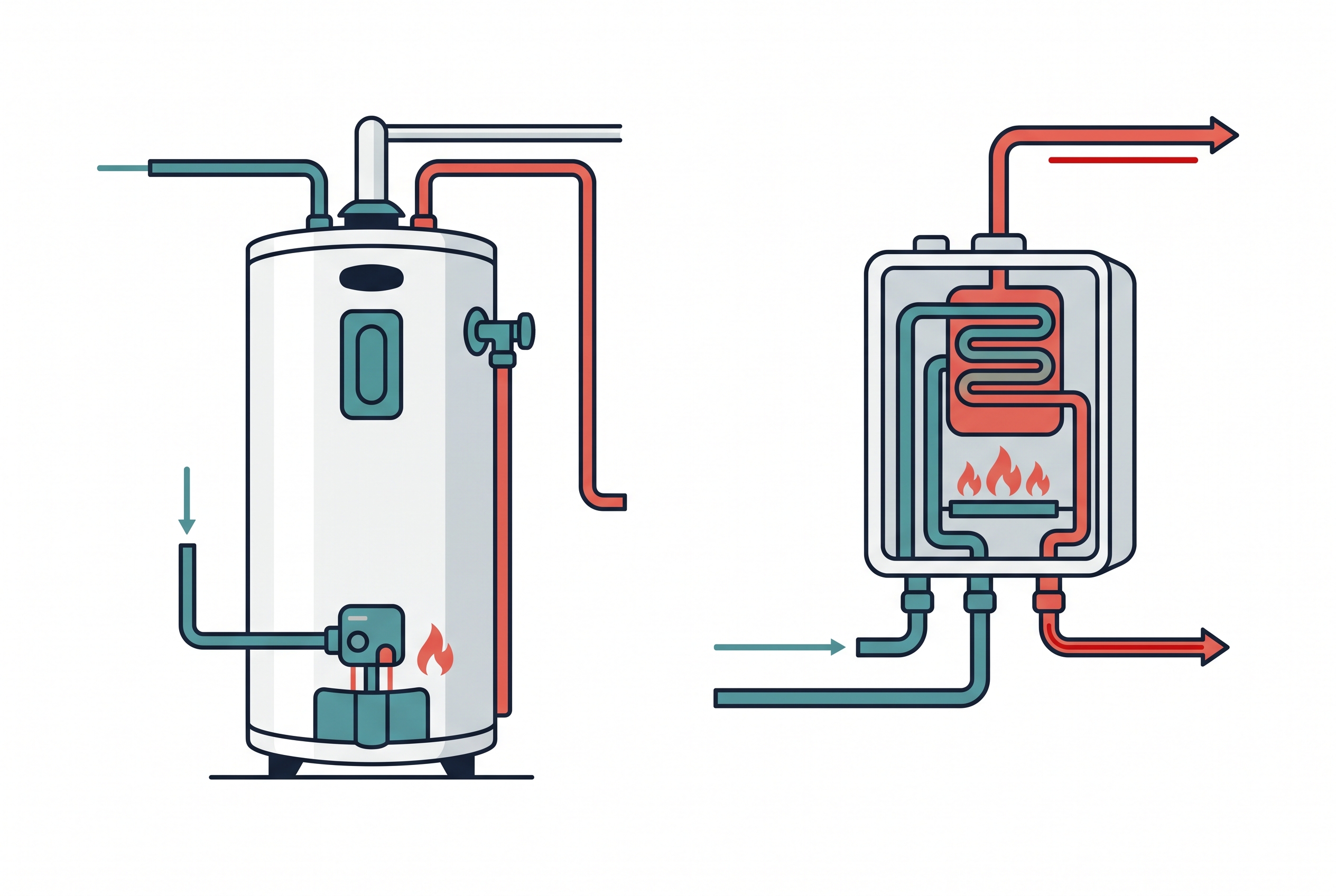
Homeowners convert to tankless for four reasons: endless hot water, higher efficiency for low-use households, reclaimed space, and a longer serviceable lifespan. Tankless installation, especially Rinnai, is one of the things Sherwood Plumbing is known for locally. When customers ask Devin why anyone would convert from a tank to a tankless, those four reasons come up:
You never run out of hot water. Two or three kids in sports, back-to-back showers after practice, a dishwasher running while someone else is in the laundry — that’s where tank water heaters stop and tankless keeps going. The hot water doesn’t end because there’s no tank to drain.
Tankless is efficient, especially if you’re using less. Retirees and empty-nesters tend to be the other side of the customer base. A tank water heater spends most of its life keeping 50 gallons of water hot whether you’re using it or not. A tankless only fires when water actually flows. The energy savings show up most for households that aren’t running hot water all day.
The space-saving is real. Devin’s line: tankless is the size of a carry-on suitcase. If your tank water heater currently lives in a closet, you get the closet back. In a garage, you get a wall back. In a tight Villebois or Charbonneau utility room, that matters.
Tankless is serviceable. Tank water heaters have a hard end-of-life. When the tank itself fails, the unit’s done; there’s no repair. Tankless units are more like a vehicle. Flow sensor, igniter, heat exchanger: these are individual components that get replaced over a 15- to 20-year service life. The long-run cost of ownership often beats tank because you’re not buying a new unit every 8 to 12 years.
Tankless doesn’t make sense for every house, though. Undersized gas lines need to be upgraded. Water hardness has to be addressed (scale eats tankless units faster than tank). Retrofit costs can be significant if the venting has to be reconfigured. We give an honest assessment on-site, including what your house specifically would take and what it’d run, before any work starts.
TANKLESS REPAIRTankless water heater repair and service (Rinnai and others)
A tankless water heater that stops heating, cycles hot and cold, or shows an error code usually has one of a few causes, and most of them are repairable. We service the Rinnai units we install and the tankless brands we find already installed in Sherwood-area homes.
Scale on the heat exchanger. Minerals build up inside the unit over time and make it overheat or shut down. A descaling flush clears it, and regular flushing keeps it from coming back.
Gas supply or venting problems. A tankless burns a lot of gas for short bursts. An undersized gas line, a blocked vent, or a failing igniter or flame sensor will make the unit throw an ignition error and quit.
Low flow. A clogged inlet filter or a fixture running below the unit’s minimum flow keeps the burner from firing, which feels like the hot water comes and goes.
Worn parts. Flow sensors, fans and control boards wear out. On a unit that is otherwise sound, replacing the part costs far less than replacing the heater.
We read the error code, test gas pressure and venting, and tell you in writing what we found and what it will take before any work starts. If the unit is near the end of its life, we tell you that too. See slab leak detection if you suspect a hidden leak instead.
WHAT'S INCLUDEDWhat does a water heater replacement include?
A water heater replacement includes hauling away the old unit, setting and connecting the new one (water, gas or electric, venting, expansion tank), pulling the city permit, and a pressure test — all quoted on-site with a written price before work starts. Replacing a unit for a business, multi-family building, or tenant space runs through our commercial plumbing service instead. Every replacement is quoted on-site after we see the actual installation. That keeps us honest with you, and it saves us both from the back-and-forth that happens when a phone quote turns into a different number once we open the closet. The variables that move the price:
- Whether the new unit is gas or electric, tank or tankless.
- Whether expansion tanks, gas flex lines, or venting components need upgrading to current code.
- Whether we need to permit the install with the city (required in most cases in Oregon; we handle the permit).
- Whether the old unit has to be drained, disconnected, and hauled away (usually yes, included).
- Whether the gas line capacity supports the new unit’s BTU rating (especially relevant for tank-to-tankless conversions).
You get a written quote before any work starts. For straightforward replacements you’re billed on completion. For larger projects (anything that runs longer than a single service-call window, or involves repiping or significant venting work) we collect a deposit at the start and work through a milestone pay schedule. If the project pulls in a whole-home repipe, see our repiping page.
OUR PROCESSHow does a water heater service visit work?
You call or text (503) 822-5070, a tech inspects the unit and walks you through the failure, and small fixes are often handled same-visit while replacements are scheduled after you approve a written quote. Our office picks up during business hours.
A tech shows up, inspects the unit, and goes through the failure mode with you. If the fix is small (a thermocouple, an igniter, an anode swap), we can often handle it on the same visit. If it’s a replacement, we confirm the unit you want, order or pull from stock, and schedule the install.
On install day: drain the old unit, disconnect gas or electrical, remove it, haul it out. Set the new unit. Connect water, gas/electric, venting, expansion tank if required. Fill, pressure-test, fire up. Leave you with the temperature set correctly and paperwork for any warranty pass-through from the manufacturer.
Payment at the end: credit card or check.
GOOD TO KNOWWhat are the most common water heater problems?
The most common water heater failures we fix are no hot water, lukewarm or insufficient hot water, rumbling or popping noises, leaks, and rotten-egg odor — each points to a different cause and fix:
No hot water at all
Gas tank: pilot out, thermocouple failed, gas valve stuck. Electric tank: lower element burned out, thermostat failed, breaker tripped. Tankless: flow sensor, igniter, gas supply. Diagnostic is usually quick once we’re on site.
Lukewarm water or not enough hot water
Undersized for the household, sediment buildup reducing effective tank volume, dip tube broken and mixing cold into hot, thermostat out of adjustment. A sediment flush sometimes solves it. Other times it’s a sign the tank’s done.
Rumbling, popping, or banging noises
Sediment has accumulated on the bottom of the tank and water is boiling through it. A flush can help early on. Past a certain point the sediment has calcified and flushing doesn’t fully clear it. The tank is on borrowed time.
Leaking from the top, bottom, or sides
Top leak: fittings, T&P valve, cold inlet. Usually fixable. Bottom or side leak from the tank itself: the tank is failing and needs replacement. There is no way to patch a leaking tank safely. If the leak is somewhere outside the unit but you’re not sure where, see our leak detection page.
Rotten egg smell in hot water
Anode rod reacting with bacteria in the water. Swap the anode (often to aluminum-zinc instead of magnesium) and sanitize the tank.
WHERE WE WORKService area
Sherwood Plumbing is at 22800 SW Conifer Drive, covering a 25-mile radius across Washington County with parts of Clackamas and Yamhill:
Water heaters are the job we run most often outside Sherwood. For local detail — permits, typical timing, and what the housing stock in each city tends to need — see water heater repair in Tigard and water heater replacement in Tualatin.


ABOUT SHERWOOD PLUMBINGAbout the shop
Sherwood Plumbing has been running since 2013 under Devin Drew Adams. We’re headquartered in Sherwood, the only plumbing company actually based in town. Our techs know the housing stock around here: the 1970s gas tank in a Sherwood ranch, the 2015 tankless in a Villebois build, the electric tank in a Cedar Hills postwar home. That local knowledge is the difference between a diagnosis that takes 20 minutes and one that takes two hours.
We carry $1,000,000 in general liability insurance with Federated Mutual. Oregon CCB license #200851 (Plumbing, Residential RGC General Contractor). PB1381 with the Oregon Building Codes Division. $25,000 surety bond through Contractors Bonding & Insurance. 220 Google reviews at 4.7 stars.
FREQUENTLY ASKED QUESTIONSFrequently asked questions
A like-for-like tank swap usually runs 2 to 4 hours on site once we arrive with the unit. Tankless installs take longer, typically a full day, because gas line and venting often need to be reworked. We tell you the expected timing before the appointment.
For the right house, yes. For a family of two in a single-bath home, usually not; payback takes too long. For a 4-person household with simultaneous hot-water demand, or a home where mechanical closet space is a premium, tankless can make financial and practical sense. We give you an honest look at your specific house, not a sales pitch.
The most common causes are scale buildup on the heat exchanger, a gas supply or venting problem, and low water flow from a clogged inlet filter. The error code on the unit usually points to which one. A descaling flush, a vent or gas fix, or a filter cleaning resolves most cases without replacing the heater.
Rinnai and most manufacturers recommend flushing a tankless at least once a year. Homes with harder water or heavy hot-water use may need it more often. A yearly flush is part of the Sherwood Plumbing membership.
For a typical 3- to 4-person Sherwood household, a 40- to 50-gallon tank is standard. Larger families or homes with higher simultaneous demand (multiple bathrooms running at once) often size up to 60 to 80 gallons or move to tankless. Electric tanks usually need to be one size larger than equivalent gas because recovery is slower.
In most Oregon jurisdictions, yes. Water heater replacement is a permitted install. We handle the permit as part of the job.
Most tank water heaters ship with a 6- or 12-year manufacturer warranty on the tank and a shorter warranty on parts. Tankless units typically run longer warranties (10 to 15 years on the heat exchanger). If a unit we installed fails inside its manufacturer warranty, we handle the warranty replacement. You don’t deal with the manufacturer paperwork; we do. The manufacturer covers parts only, per their term. Labor is separate once Sherwood’s own labor warranty has elapsed. That’s industry-standard, and we’re straight with you about it before we install anything.